Installation of Reinforced Laminate in New Swimming Pools
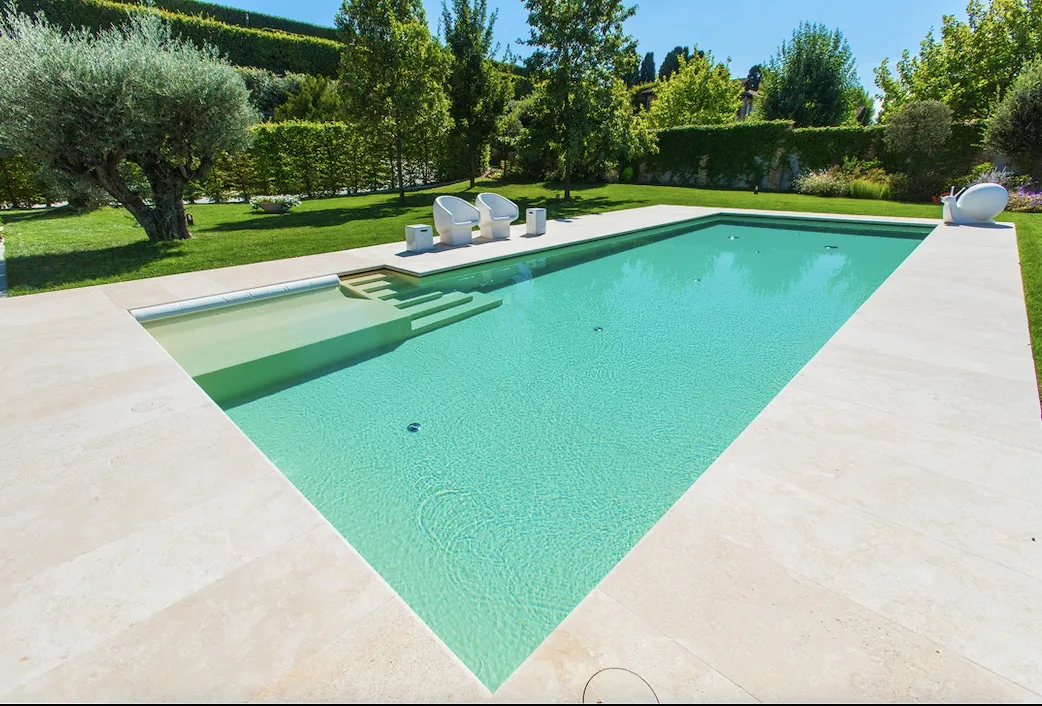 Reinforced liner, the smart choice for your new pool
If you are building the pool of your dreams, reinforced liner is the lining of the future. At ARG Piscinas, we install reinforced liner in newly built pools, offering an impeccable finish, guaranteed watertightness from the first filling, and savings in structure and materials. Forget the problems of traditional pools and enjoy a smooth, modern, and easy-to-maintain surface.
Reinforced liner, the smart choice for your new pool
If you are building the pool of your dreams, reinforced liner is the lining of the future. At ARG Piscinas, we install reinforced liner in newly built pools, offering an impeccable finish, guaranteed watertightness from the first filling, and savings in structure and materials. Forget the problems of traditional pools and enjoy a smooth, modern, and easy-to-maintain surface.Why use foil cladding from day one?
In new-build projects, the cladding is chosen without the pressure of a leak, and that’s where the difference between welding and tiling becomes apparent after ten years.
A continuous surface
The sheet metal is hot-welded to form a single surface that matches the exact geometry of the vessel. There are no joints: there is nowhere for it to start failing.
It adapts to any shape
The pattern is cut out from a flat pattern for that glass, complete with its ridges, rims and special features.
Your finish is a choice, not something you’re born with
Seven collections featuring different textures, relief patterns and non-slip finishes, rather than a limited range of tiles.
How to install it, step by step
Phase 1 — Site visit and plans
The glass is measured using a laser tape measure and the pattern is decided: how many panels, how they are arranged, the direction of the joints, and where the profiles and fittings are positioned.
Phase 2 — Perimeter profiles
The fixing profiles, made of stainless steel or PVC, are secured to the upper edge using specialised fasteners and sealant. They provide the physical attachment for the sheet: their alignment and level determine the final result.
Phase 3 — Geotextile
A non-woven cushioning layer weighing 200–300 g/m² covering the entire glass surface. It absorbs minor irregularities, insulates the sheet from direct contact with the concrete and reduces the amount of cold transferred from the glass to the membrane.
Phase 4 — Pattern-making and layout
The sheets are cut according to the calculated pattern and laid out on the geotextile, leaving overlaps of 4–5 cm at all joints. Their position is checked before starting up a single machine.
Phase 5 — Hot welding
Hot air at between 350 and 450 °C fuses the two layers of PVC in the overlap to form a seamless joint with the rest of the material. First, an automatic pass is carried out along the straight sections, followed by manual finishing at corners, angles and fittings.
Phase 6 — Checking each joint
Each weld is checked using a test probe: this is inserted into the joint and, applying moderate pressure, confirms that the joint is continuous and free of channels. Any weld that fails the test is redone immediately.
Phase 7 — Sealing and commissioning
The perimeter joints and fittings are sealed using the manufacturer’s sealant, which has the same chemical composition as the membrane. The system is filled whilst the filtration process is underway.
How can you check that it won’t leak?
Watertightness is not guaranteed: it is checked on site, joint by joint, before the pool is filled.
Welding between 350 and 450 °C
The hot air melts the two layers of PVC in the overlap and creates a seamless bond with the rest of the material. It is not a glued joint: it is the same material, forming a continuous whole.
A test probe at each joint
It is inserted into the weld and, applying moderate pressure, checks that the joint is free of channels. Any joint that fails the test is reworked immediately, not later.
Chemical seal, not mechanical
The manufacturer’s liquid has the same composition as the membrane: in profiles, skimmers, nozzles and spotlights, the seal is chemical and permanent.
Geotextile weighing 200–300 g/m²
Underneath the sheet, it absorbs the micro-irregularities of the substrate and insulates it from the concrete, which is what prevents wear caused by friction over the years.
What people ask us before signing up
Why choose reinforced liner for a new swimming pool?
Because it is hot-welded and forms a continuous surface, without the joints where mosaic tiles tend to fail over the years. The technical process is described in Step-by-step installation.
What are the steps involved in building a swimming pool in Spain?
Permits, project, civil engineering works and cladding. We go through it all in A guide to building a swimming pool.
Which finish should I choose?
They vary in texture, thickness and slip resistance. We compare the collections in Which ALKORPLAN collection to choose.
How much does it cost to line a new swimming pool?
For an 8 × 4 m pool, between €4,000 and €6,500 including installation, or €50–70 per square metre. The breakdown is available at the 2026 price guide.
What maintenance is required afterwards?
The usual water, without any special treatment. The month-by-month calendar is available at the monthly maintenance guide.