Reinforced sheet in fiberglass or polyester pools
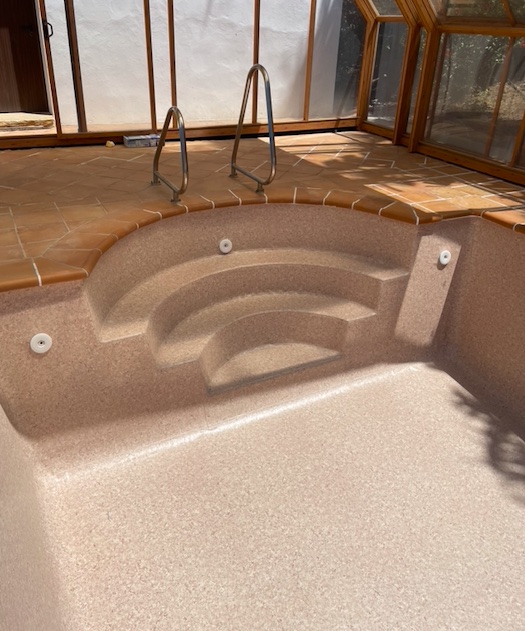 Say goodbye to osmosis in your fiberglass pool Polyester and fiberglass pools often suffer from osmosis over time, causing annoying bubbles, black spots, or leaks. At ARG Piscinas, we offer the definitive solution: the installation of reinforced liner on the fiberglass shell. This system creates a completely watertight barrier that eliminates polyester problems, completely renovating the surface and guaranteeing years of use without porosity or bubbles.
 Signs that the gelcoat is failing
A fibreglass swimming pool is manufactured in a single piece, with an inner finish layer — the gel-coat — which is the only real barrier between the water and the laminate. When that layer fails, what you see on the surface is already coming from deeper down.
Bubbles and blisters
It’s osmosis: water is absorbed into the laminate and forms blisters beneath the surface.
Discolouration
The gelcoat is losing its colour in patches and can no longer be restored by treatment.
Superficial chipping
The surface becomes rough to the touch and traps dirt.
Cracks that reappear every year
They reappear in the same place because the problem is fatigue in the laminate, not the crack.
Why fibreglass swimming pools fail
How to install it, step by step
Phase 1 — Site visit and plans
The glass is measured using a laser tape measure and the pattern is decided: how many panels, how they are arranged, the direction of the joints, and where the profiles and fittings are positioned.
Phase 2 — Perimeter profiles
The fixing profiles, made of stainless steel or PVC, are secured to the upper edge using specialised fasteners and sealant. They provide the physical attachment for the sheet: their alignment and level determine the final result.
Phase 3 — Geotextile
A non-woven cushioning layer weighing 200–300 g/m² covering the entire glass surface. It absorbs minor irregularities, insulates the sheet from direct contact with the concrete and reduces the amount of cold transferred from the glass to the membrane.
Phase 4 — Pattern-making and layout
The sheets are cut according to the calculated pattern and laid out on the geotextile, leaving overlaps of 4–5 cm at all joints. Their position is checked before starting up a single machine.
Phase 5 — Hot welding
Hot air at between 350 and 450 °C fuses the two layers of PVC in the overlap to form a seamless joint with the rest of the material. First, an automatic pass is carried out along the straight sections, followed by manual finishing at corners, angles and fittings.
Phase 6 — Checking each joint
Each weld is checked using a test probe: this is inserted into the joint and, applying moderate pressure, confirms that the joint is continuous and free of channels. Any weld that fails the test is redone immediately.
Phase 7 — Sealing and commissioning
The perimeter joints and fittings are sealed using the manufacturer’s sealant, which has the same chemical composition as the membrane. The system is filled whilst the filtration process is underway.
What changes when using reinforced PVC cladding?
The sheet is fitted over the fibreglass hull and creates a new watertight barrier over the damaged gel-coat.
Stop osmosis
The laminate is no longer in contact with the water, which is what drives the process.
Returns a smooth surface
No more chipping or rough patches – no need to sand or repaint every season.
Change the colour of the swimming pool
The finish is chosen from one of the seven collections; it is not carried over from the original gel-coat.
the article on fibre and polyester
What people ask us before signing up
Can reinforced liner be laid over polyester?
Yes, and it’s the usual solution when osmosis occurs or the gelcoat loses its colour. The case is discussed in reinforced liner in polyester and fibreglass swimming pools.
What is osmosis and why does it occur?
This is the formation of blisters caused by water being absorbed into the laminate, beneath the gel-coat. Further details at the article on fibre and polyester.
How much does it cost per square metre?
reinforced liner metal costs around €50–70 per square metre, fitted, depending on the range and the condition of the hull. The full price ranges can be found at the price guide per square metre.
Does the gelcoat need to be repaired first?
Any necessary repairs are carried out to ensure the support is secure; the sheet metal will not cover a loose shell. The items in a full budget are listed in the 2026 price guide.
What finishes are available?
The seven RENOLIT ALKORPLAN collections, each with different textures, patterns and anti-slip finishes. We compare them in Which ALKORPLAN collection to choose.