Pool Grout: Common Problems and Alternatives
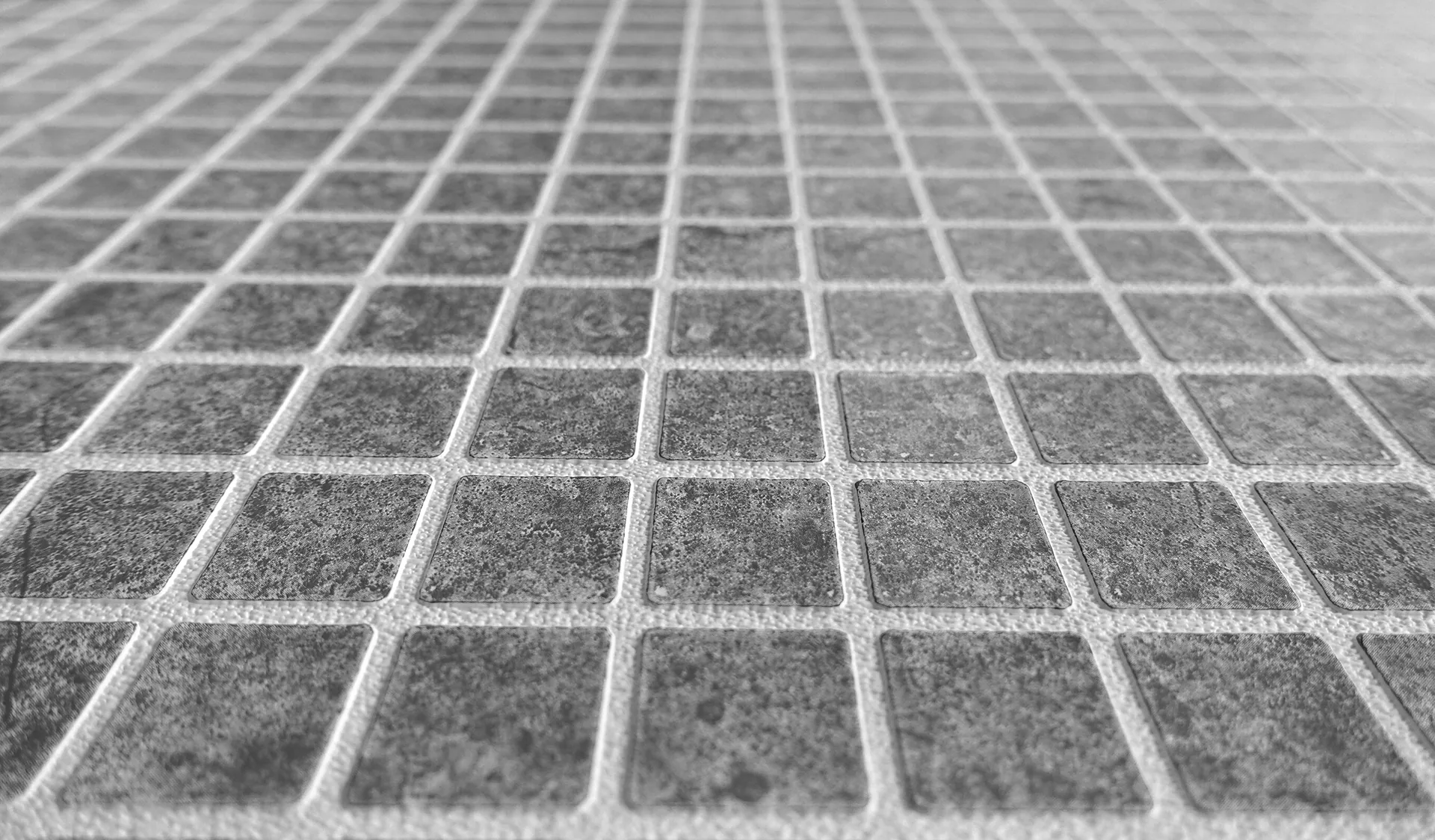
For decades, mosaic tiles were the most common pool lining in Spain. Its bright, colorful appearance and resistance to chemicals made it the standard choice starting in the 1970s. However, over time, many homeowners have discovered that gresite leads to recurring problems that are costly and difficult to resolve permanently.
Loose or Detached Tiles
This is the most visible problem. The main cause is the loss of adhesion in the setting mortar due to cycles of thermal expansion and contraction, impacts, or simply the passage of time. Once tiles begin to fall off, the process accelerates because water penetrates the exposed areas and erodes the adjacent mortar. Repairing individual loose tiles costs between 300 and 800 euros, depending on the area, but rarely solves the problem permanently.
Blackened and Algae-Covered Grout Lines
The grout lines between tiles are the weakest point of the mosaic. This network of porous grout traps microorganisms, algae, and dirt that chemical products cannot completely remove. The result is permanently dark or greenish grout lines that are practically impossible to whiten permanently without draining the pool and treating each joint individually—a process that can cost between 600 and 1,500 euros.
Leaks Through the Mortar
The mosaic tiles themselves are waterproof, but the entire system—tiles, mortar, and base—is not if microcracks are present. Traditional mortar becomes permeable over time, especially in high-stress areas such as corners, changes in level, or around drains. Detecting and sealing these leaks may require costly watertightness tests and partial repairs that do not always resolve the underlying problem.
Discoloration and Loss of Luster
The colors of the mosaic tiles—especially the brighter blues and greens—can lose their intensity after years of exposure to chlorine and UV rays. This process is irreversible and negatively affects the pool’s appearance.
When to Repair and When to Replace the Mosaic Tiles
If the problems are isolated—affecting less than 10% of the surface area and with no active leaks—repair may be a reasonable option. If tiles are falling out in multiple areas, there are widespread joints in poor condition, or there are diffuse leaks, the cost of repair approaches that of a complete replacement, which will always last longer.
Reinforced PVC Liner as a Permanent Alternative
Reinforced PVC liner has become the preferred alternative for renovating pools with deteriorated mosaic tile. It is a seamless, continuous system that eliminates the weakest point of the mosaic tile. It acts as a completely watertight barrier; its smooth surface makes cleaning much easier, and in most cases, it can be installed directly over the existing mosaic tiles without the need to chisel them out, reducing construction time to 3 to 5 days. Its useful life is 15 to 25 years with basic maintenance.
Cost Comparison
For an 8x4-meter pool, a complete tile repair costs between 3,000 and 6,000 euros, with an additional service life of 5 to 10 years at most. Installing a reinforced liner over the existing tile work costs between 4,000 and 7,000 euros and comes with a watertightness warranty of more than 20 years.
If your pool has any of these problems, request a free inspection. Our technicians will assess the condition of your pool lining and offer you the most efficient and cost-effective long-term solution.
You may also be interested in
Reinforced Liner in Chiclana de la Frontera: Pool Installation and Renovation · Reinforced Liner in El Puerto de Santa María: Pool Installation and Renovation in the Bay of Cádiz · Pool Renovation with Reinforced Liner: Everything You Need to Know
https://www.argpiscinas.es/en/blog/gresite-piscina-problemas-alternativas